
GCC talent acquisition is the process of sourcing, hiring, and building talent for Global Capability Centres, in-house offshore units that MNCs set up in India to run product engineering, R&D, shared services, or specialized functions like finance and IT.
It differs from standard corporate hiring in a few keyways: it’s built around skill clusters rather than job titles, it depends on deliberate build-versus-buy decisions, it prices roles across three different compensation speeds within the same city, and it increasingly has to account for global compliance mandates tied to the parent company’s worldwide operations.
It matters because getting this wrong shows up directly in cost, delay, and mandate risk. 24% of GCCs name talent quality mismatch as their top hiring constraint, concentrated in exactly the roles, AI/ML, cloud, product engineering, that are growing fastest in demand.
Only 20% of GCCs report a tangible return on their AI hiring investment so far. Scaling hiring predictably, without the cost overruns and quality gaps most GCCs hit, takes more than “hire faster.” It takes a deliberate strategy.
That strategy comes down to six moves: anchoring hiring in real demand signals rather than headcount targets, mapping skill clusters before opening a requisition, deciding deliberately between building and buying talent, designing compensation around skill scarcity and location, governing the hiring funnel as one connected system instead of isolated tools, and forecasting capability needs 12–18 months ahead.
Here’s what each one looks like in practice.
GCC Talent Acquisition Strategies
| S.No | Strategy | What it answers | Where it breaks down if skipped |
| 1 | Anchor hiring in real demand signals | What are we actually hiring for, and why now? | Reactive, backfill-driven hiring |
| 2 | Map skill clusters before opening a requisition | Where does that talent live, and is it even a hiring problem? | Requisitions open with no realistic candidate pool |
| 3 | Decide deliberately between building and buying | Do we hire it externally or grow it internally? | Overpaying externally for what could be built, or waiting too long for what needed buying |
| 4 | Design compensation around scarcity and location | What does this role actually cost, right now, in this location? | Offers lose to competitors on stale bands |
| 5 | Govern the hiring funnel as one connected system | Is the hiring process efficient and improving? | Slow, leaky funnels that AI tools speed up without fixing |
| 6 | Forecast capability needs 12–18 months ahead | What capabilities will we need over the next 12–18 months? | Quarter-by-quarter planning that ends in hiring crises |
Get the full data: Download the GCC Talent Lab Report 2026 for the complete dataset behind every strategy, based on 100+ CHROs and TA heads across India’s GCC ecosystem.
Strategy 1: Anchor Hiring in Real Demand Signals, Not Headcount Targets
More than half of GCCs plan to increase hiring in FY27, up from 47% the year before, and the sector could generate around 1.5 lakh new roles.
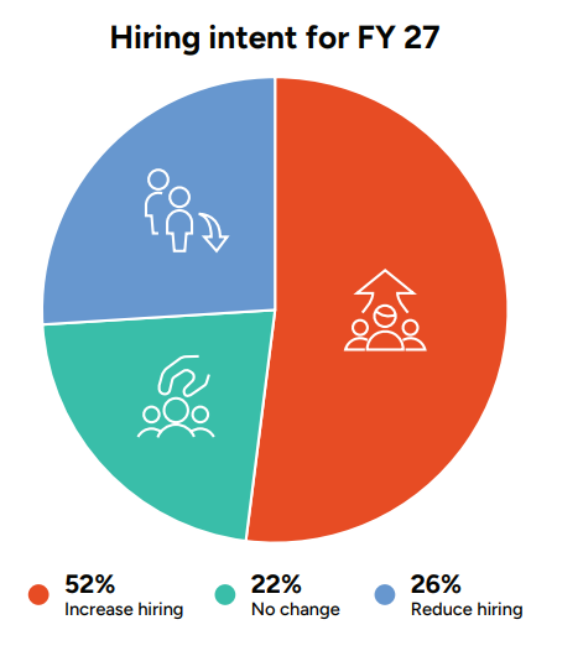
On paper, that’s growth. But the shift that matters isn’t in volume, it’s in governance.
GCCs are moving away from reactive, backfill-driven recruitment toward programmatic hiring: budgeted, forecasted, and tied to capability roadmaps set months in advance.
A GCC talent acquisition strategy cannot be built around requisitions alone. Before any sourcing plan gets built, a GCC needs a precise answer to what it’s hiring for, not just how many people. AI is the clearest example of why this matters.
Nearly half of GCCs say more than a quarter of their open roles now require AI-related capability, and one in four say most of their roles already do. A headcount target that doesn’t specify this gets filled with the wrong profile.
The demand signal should also account for experience mix. Early-career hiring (freshers plus 1–5 years) makes up roughly 46% of the expected FY27 mix, while the 6–10 year band, at 28%, is where GCCs increasingly place bets on capability ownership rather than execution.
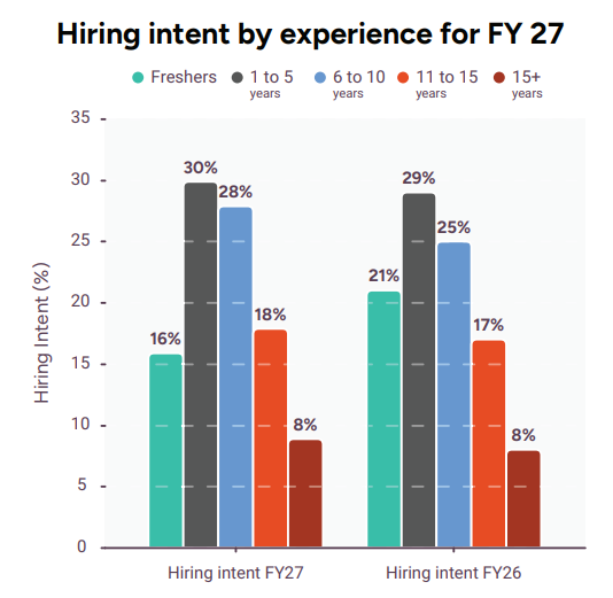
Those are different hiring motions with different sourcing timelines, and a single “headcount” number collapses with that distinction.
Demand isn’t always visible in today’s requisitions, either. New product mandates, global delivery responsibilities, and regulatory requirements can create skill demand 12–18 months before the corresponding roles appear in the hiring plan. A GCC expanding its global mandate, for example, may need professionals with domain-specific regulatory and compliance fluency well before those requirements show up in a formal requisition. A demand signal that only looks at current open roles misses this kind of forward pressure entirely, and by the time it shows up as a requisition, competitors who read it 12 months earlier already have a head start.
For the full FY27 demand picture: GCC Hiring Trends in India 2026.
Strategy 2: Map Skill Clusters Before You Open a Requisition
Once demand is defined, the next question isn’t “can we hire this.” It’s “does this skill genuinely exist in the market at the scale, location, and seniority we need.” Most GCCs skip this step and discover the gap mid-requisition.
A skill cluster is only ready for scale hiring when it clears five conditions at once: sufficient supply, trainability at entry level, demonstrable retention at mid and senior levels, a clear career progression path, and a cost structure that stays competitive.
Clusters that clear all five can support a large, predictable hiring plan. Clusters that clear three or four need smaller cohorts and active retention work. Clusters that clear fewer than that usually aren’t hiring problems at all, they’re institution-building problems that need a centre of excellence or academic partnership before recruiting can even start.
That last distinction, hiring problem versus institution-building problem, is the single most useful filter a CHRO can apply before a req goes live.
For the full skill-cluster framework and worked examples: Skill Mapping for GCCs: A CHRO’s Guide to Smarter Sourcing.
Strategy 3: Decide Deliberately Between Building and Buying Talent
Once a skill cluster is mapped, a GCC has to choose how to access it. Across the GCCs surveyed, the talent model still leans heavily toward Buy: 78% of capability is sourced externally, while 22% is developed internally.
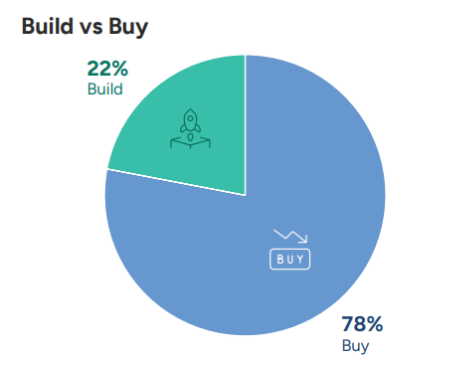
Buy makes sense where the market has what internal development can’t produce fast enough: credentialed expertise, niche specializations, or talent that needs to contribute from day one.
The external market itself isn’t one pool.
IT services firms supply 41% of external hires, bringing scale and process discipline but often needing time to shift from delivery-led work to product ownership.
Other GCCs supply 32%, the fastest to onboard and the riskiest: one in three hires now comes from another GCC, which means the total talent pool isn’t growing, just circulating at a higher price.
Startups and product companies supply 27%, bringing outcome-driven thinking at the cost of competing with equity-based pay.
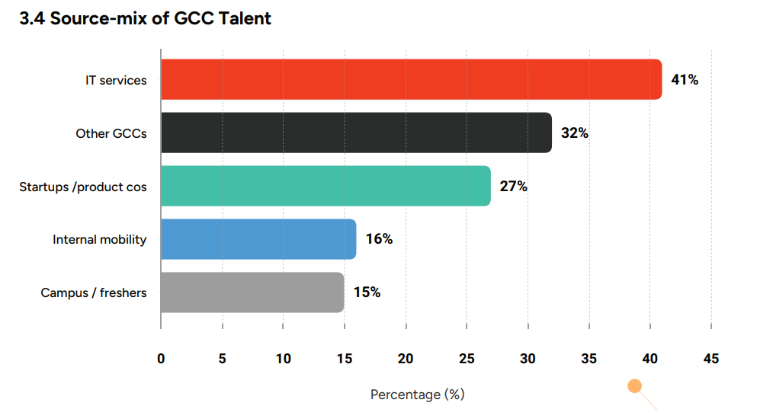
Build makes sense where long-term ownership matters: AI/ML fluency across functions, product engineering depth, data governance, leadership pipelines. Within the Build portion, internal mobility accounts for 52% and campus/fresher hiring for 48%, GCCs redeploying existing capability and shaping early-career talent in parallel.
The wrong version of this strategy is defaulting to Buy because it’s faster, without asking whether the capability being bought is one the GCC will need to keep buying, at rising cost, every year after.
Strategy 4: Design Compensation Around Skill Scarcity and Location
A TA strategy built on stale compensation bands fails quietly, offers go out, candidates decline, and nobody traces it back to pricing. GCC compensation isn’t one market. Inside a single city, F&A, technology/engineering, and AI/ML each move at a different rate.
GCC salaries already run 20% above equivalent non-GCC roles, with a projected 10.4% increment for 2026.
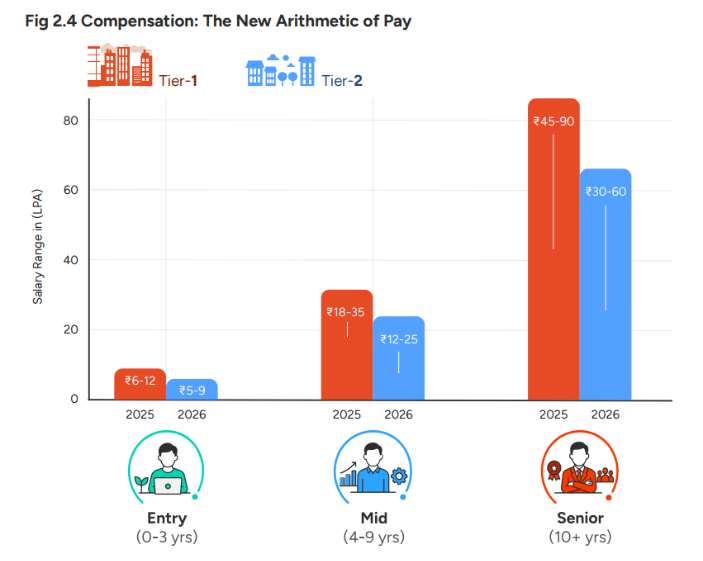
AI/ML talent carries roughly a 1.7x premium over standard tech pay, with junior AI/ML salaries inflating 40–50% year-on-year, a swing large enough to make a comp band built even a year ago obsolete.
Tier-2 cities complicate the picture further: entry-level pay there has grown at a percentage rate matching or exceeding Tier-1, even though absolute numbers stay lower, meaning the cost arbitrage a Tier-2 hiring plan assumes needs a yearly recheck, not a one-time baseline.
For the full domain-by-domain salary data: GCC Salary & Compensation Trends 2026.
Strategy 5: Govern Your Hiring Funnel as One Connected System
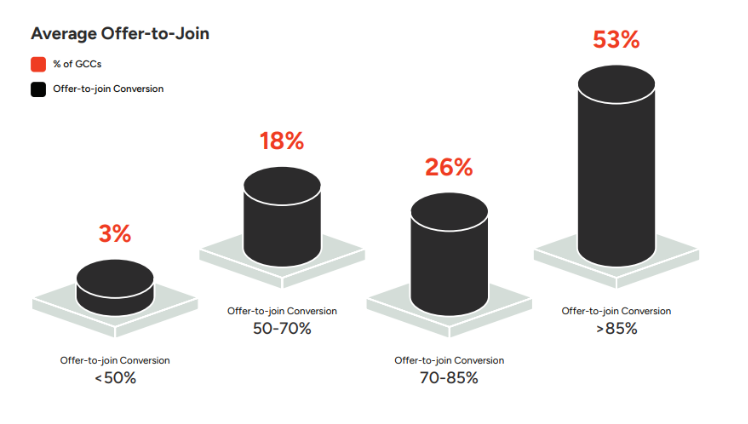
This is where most GCCs have already invested the most, and where the return has been the most disappointing. Offer-to-join conversion now averages around 80%, up from 70–75% a year ago, real progress.
AI adoption in hiring has crossed 90% of GCCs. And yet only 20% report a tangible, measurable impact from that AI investment.
The reason: most GCCs deployed AI stage by stage, a screening tool here, a sourcing tool there, each solving its own slice of the funnel without passing information to the next stage.
A signal about a candidate’s compensation expectations, picked up during screening, rarely reaches the team structuring the offer. Every individual task gets faster. The system underneath doesn’t get smarter.
That’s why time-to-fill for specialist roles, AI architecture, cybersecurity, cloud engineering, stays stubbornly slow (30% of these roles take 60–90 days, 18% take longer) even as overall funnel metrics improve.
The fix is connecting the stages, not adding more tools to them, the shift toward agentic hiring systems where AI handles execution and recruiters shift into a governance role.
For the full diagnosis, check out this blog on Quality of Hire Metrics: Why Is GCC Hiring Getting Faster But Not Better?
Strategy 6: Forecast Capability Needs 12–18 Months Ahead
This is different from quality of hire, which measures whether a specific person worked out after joining. Capability forecasting happens before that, deciding what skills and leadership a GCC will need over the next year or more, so hiring isn’t a reaction to a seat opening.
The GCCs building the most dependable talent engines treat workforce planning as a strategic function, anticipating capability needs well ahead of time, making build-versus-buy calls proactively, and keeping the talent pyramid from over-indexing on lateral hiring. Organizations that plan quarter-by-quarter are the ones that end up in hiring crises.
Leadership capability is one of the clearest examples of why this forecasting can’t stop at today’s requisitions. Leadership hiring has surged roughly 40%, but the supply of leaders who can navigate a global matrix, build culture in a new location, and balance India execution with HQ expectations remains thin.
If that demand is only identified when the requisition opens, the GCC is already late, because leadership hiring is rarely something a market can fill on short notice. It depends entirely on how far ahead an organization was planning.
What connects all six strategies
None of these strategies is difficult on its own. Most GCCs already do some version of all six. What’s usually missing is the connective tissue: the demand signal from Strategy 1 should directly shape the skill maps in Strategy 2, which should directly shape the build-versus-buy calls in Strategy 3, which should directly shape the comp bands in Strategy 4, which should feed the funnel governance in Strategy 5, which should feed back into the capability forecast in Strategy 6.
When these run as six separate initiatives, owned by six different people, on six different timelines, the result is exactly what shows up in the data: quality mismatch as the top-cited hiring constraint, leadership pipelines that thin out precisely when needed, and AI tools that speed up individual tasks without making the system smarter.
A GCC talent acquisition strategy earns that word, strategy, only when these six moves work together.
Building and running this as one connected system, market intelligence, skill mapping, sourcing strategy, compensation design, and AI-enabled execution working from the same forecast, is a significant operational lift.
For newer or fast-scaling GCCs, this is where a specialized talent acquisition or RPO partner can provide the infrastructure, market intelligence, and execution capacity needed to scale without rebuilding every layer from scratch.
FAQs
What is GCC talent acquisition?
GCC talent acquisition is the process of sourcing, hiring, and developing talent for Global Capability Centres, the in-house offshore units MNCs set up in India to run product engineering, R&D, shared services, or specialized functions. It differs from standard hiring in its focus on skill-cluster mapping, multi-speed compensation, and global mandate readiness.
What are the best talent acquisition strategies for GCCs?
The six most effective strategies are: anchoring hiring in real demand signals, mapping skill clusters before opening requisitions, deciding deliberately between building and buying talent, designing compensation around skill scarcity and location, governing the hiring funnel as one connected system, and forecasting capability needs 12–18 months ahead.
How is GCC talent acquisition different from regular corporate hiring?
GCCs hire against skill clusters that often don’t exist at scale locally, price roles across three different compensation speeds, F&A, tech/engineering, and AI/ML, within the same city, and rely heavily on adjacent talent pools like IT services firms and other GCCs rather than a single standard hiring channel.
What is the biggest challenge in GCC talent acquisition today?
Quality mismatch is the top-cited constraint, flagged by 24% of GCCs, concentrated in AI/ML, cloud, and product engineering roles, where candidates often meet the skill keywords on paper without the demonstrable depth the role needs.
Should GCCs build talent internally or hire externally?
Across GCCs surveyed, 78% of capability is sourced externally (Buy) and 22% is developed internally (Build). Buy suits urgent, credentialed, or niche needs. Build suits capabilities a GCC wants long-term ownership over, such as AI/ML fluency or leadership pipelines.
What is capability forecasting in GCC hiring?
Capability forecasting means planning what skills and leadership a GCC will need 12–18 months ahead, rather than reacting one requisition at a time. It’s distinct from quality of hire, which measures whether a specific hire worked out; forecasting is about anticipating demand before it becomes urgent.
How often should a GCC revisit its talent acquisition strategy?
At least annually, and ideally on a rolling 12–18 month cycle. Compensation bands, skill scarcity, and demand signals shift quickly enough that a strategy built even a year ago can already be out of date, particularly in AI/ML and specialist technical roles.
For the complete dataset behind every strategy: Download the GCC Talent Lab Report 2026